
Fear of maths in students is a common challenge, especially when students find formulas, calculations, and difficult questions hard to understand. Class 6 to 10 is an important stage for building strong mathematical concepts. With the right study habits, regular practice, and proper guidance, students can gradually become more confident in Maths.
Understanding the fear of maths in students is important because it helps parents and teachers identify learning difficulties and provide the right support.
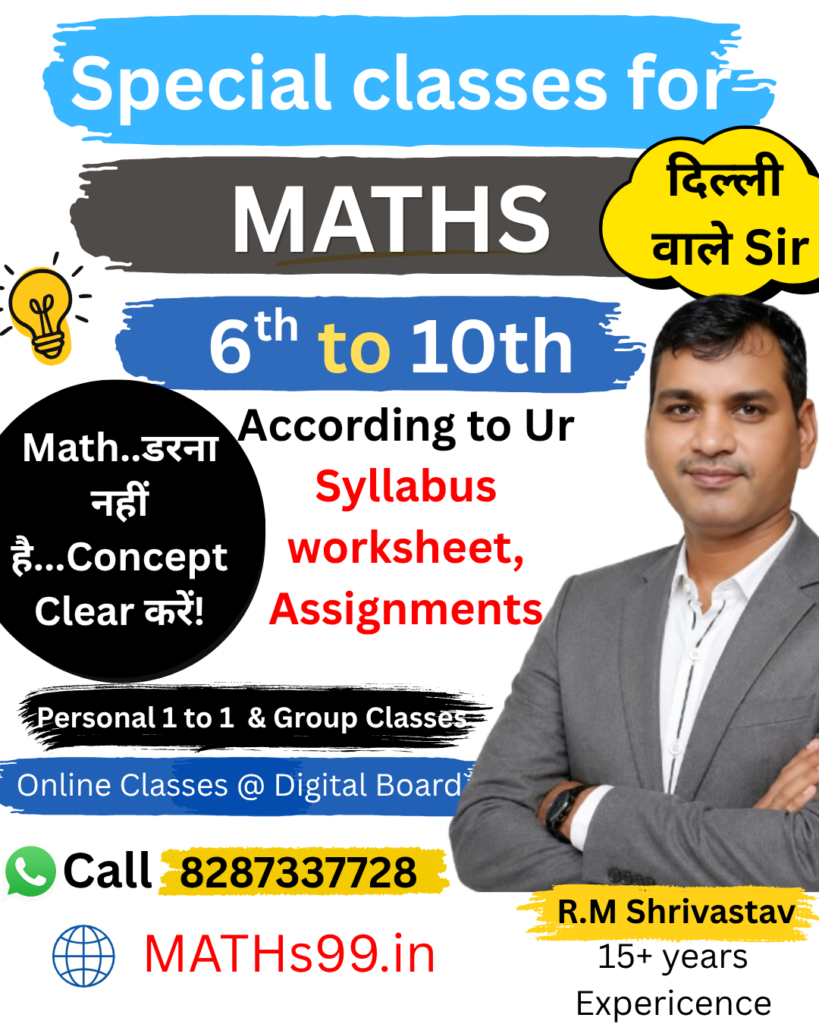
At Maths99, the aim is to help students understand Mathematics through simple explanations, examples, and step-by-step learning with R.M. Shrivastav Sir.
Why Is There a Fear of Maths in Students?
Students may develop a fear of Mathematics for different reasons. Understanding these reasons is the first step towards improving their learning experience.
- Weak basics: If earlier concepts are unclear, new chapters may feel difficult.
- Fear of making mistakes: Students sometimes worry about giving incorrect answers.
- Lack of practice: Solving too few questions can make Maths seem unfamiliar.
- Difficulty remembering formulas: Students may struggle to apply formulas in the right questions.
- Exam pressure: Time limits and difficult question papers can make students nervous.
The good news is that these challenges can be addressed with patience and a consistent study routine.
7 Easy Tips to Overcome Fear of Maths
1. Start with Basic Concepts
Before solving difficult questions, make sure your basic concepts are clear. Revise multiplication tables, fractions, decimals, integers, and basic calculations whenever needed.
For example, before learning algebraic equations, understand how to perform basic arithmetic operations. Strong foundations make advanced topics easier to approach.
Daily Practice to Reduce Maths Anxiety
Regular practice helps students become familiar with different types of questions. Instead of studying everything at the last minute, set aside a fixed time for Mathematics every day.
Start with a few simple questions and gradually move towards more challenging ones. Focus on understanding each step rather than rushing to finish.
Learn Maths Easily with R.M. Shrivastav Sir
Students often find formulas difficult because they try to memorise them without understanding their meaning.
For example, the area of a rectangle is calculated by multiplying its length by its breadth. Understanding this relationship makes the formula easier to remember and apply.
Write important formulas in a notebook and revise them regularly.
4. Learn from Your Mistakes
Making mistakes is a normal part of learning. When an answer is incorrect, check each step and identify where you went wrong.
Maintain a separate notebook for difficult questions and mistakes. Revisit these questions during revision so you can understand the correct method.
5. Divide Difficult Chapters into Small Parts
A large chapter may feel overwhelming when you try to complete it all at once.
Divide it into smaller topics. First understand the concept, then study solved examples, and finally practise questions independently.
This approach makes studying more manageable and helps you track your progress.
6. Revise Regularly Before Exams
Revision helps students remember concepts and apply them correctly. Review formulas, textbook examples, and previously solved questions every week.
Before an exam, practise questions from different chapters and attempt sample papers according to your class syllabus.
7. Ask for Help When Needed
If you do not understand a topic, ask your teacher to explain it using a different example. Do not leave doubts unresolved, because one unclear concept can affect your understanding of later chapters.
A teacher who explains concepts step by step can help you approach difficult questions with greater confidence.
How to Improve Maths in Class 6 to 10
Every class has different learning requirements. Students should focus on their current syllabus while revising any earlier concepts they find difficult.
- Class 6: Practise fractions, decimals, whole numbers, factors, multiples, and basic geometry.
- Class 7: Focus on integers, rational numbers, percentages, algebraic expressions, and lines and angles.
- Class 8: Revise linear equations, squares and square roots, exponents, and mensuration.
- Class 9: Practise number systems, polynomials, coordinate geometry, triangles, and statistics.
- Class 10: Focus on quadratic equations, arithmetic progressions, trigonometry, geometry, statistics, and probability.
Students should always follow their prescribed syllabus and textbook.
How to Overcome Fear of Maths in Students
Online learning gives students the opportunity to study from home and revisit concepts through their learning materials, where available.
Maths99 aims to make Mathematics easier to understand through concept-based learning and question practice. Students can enquire about online Maths classes with R.M. Shrivastav Sir for Class 6 to 10.
When choosing a class, check the teaching style, syllabus coverage, available timings, and opportunities to ask questions.
Build Confidence with Maths99
If you want to improve your Maths skills, start with small steps. Revise your basics, practise questions regularly, and ask for help whenever a concept is unclear.
At Maths99, R.M. Shrivastav Sir aims to help students strengthen their mathematical understanding through simple explanations and guided practice.
Want to enquire about online Maths classes?
- Call Now: 8929909708
- Website: Maths99.in